
How would YOU translate ‘Casse-toi’?

President Sarkozy is known for his temper. (Americans saw it first hand on 60 Minutes!) A recent explosion appeared the other day on the French news and is still on YouTube for all to see and hear. It’s not the explosion that I find interesting, though. It’s the difficulty of translating Sarkozy’s offense into English for Anglophones and then that translation back into French for Francophones interested in such things. The very article commenting on the challenge of these translations gets them wrong in both directions! Sarkozy loses his temper:The French article explained to Anglophone readers that “Casse-toi, pauvre con!” means “Fuck you, prick” in English. That doesn’t capture the get outa herepart of “casse-toi.” The words “the hell” or “the fuck” would have to be inserted in “Get outa here” to carry the entire meaning: “Get the hell outa here” or “Get the fuck outa here.” But that’s not the shocking part. The incomprehensible errors appear when the journalist (Le Monde’s Vincent Truffy) translates “Fuck you, prick” back into French to demonstrate the translation problem. You wonder if he knows any Americans when he says the best English translation would be “Sod off, bloody idiot” (va-t-en, idiot sanglant). Huh?

He shows us again that he was not the person to write this article by explaining “Fuck you, prick” as “Je désire avoir des relations sexuelles avec toi, espèce de pénis” The English sentence doesn’t declare anyone’s wishes but is, rather, a command. And to catch the derogatory nuance of “prick” in French, you would need to switch genders to “con.”

Of course, the English for “con” would be more vulgar than the French original so I would use “ass,”

as he does suggest or, if more vulgarity is needed, a stronger word of your choice.

As for ‘sod off,’ I assume it means ‘fuck you’ am not sure. And I never understood how « bloody » could be considered vulgar. I just as confused by the French « gueule ». How can a word for mouth or snout be considered so vulgar?
Posted in Language Tips | Tagged , , , | 9 Comments

Silly bilingual joke: Theft in Paris

A thief in Paris planned to steal some paintings from the Louvre. After careful planning, he got past security, stole the paintings and made it safely to his van.However, he was captured only two blocks away when his van ran out of gas. When asked how he could mastermind such a crime and then make such an obvious error, he replied, “Monsieur, that is the reason I stole the paintings. I had no Monet to buy Degas to make the Van Gogh.”See if you have De Gaulle to send this on to someone else. I sent it to you because I figured I had nothing Toulouse!

Posted in Language Tips | Tagged , , , , | 3 Comments

The Essence of the French

A British Euro-joke tells of a meeting of officials from various countries who listen to a British proposal, nodding sagely at its numerous benefits; the French delegate stays silent until the end, then taps his pencil and remarks, “I can see that it will work in practice. But will it work in theory?”
Posted in Only in France ! | Tagged , , , | Leave a comment

In under 2 minutes – answers to your questions about French words

Eminent linguistics professor Bernard Cerquiglini answers questions about French words from viewers all over the planet. He appears almost daily on TV5’s “Merci professeur.” Can we make “premier ministre” feminine, for example? If you are a subscriber to TV5 on your cable system, you may have seen his program there. Anyone can view these 2-minute segments by web video. The answer is here:

TV5 video (2 minutes)

Here is some background on the professor himself, from the French Wikipedia, or if you prefer, the English Wikipedia.

Posted in Language Tips | Tagged , , | Leave a comment

The French equivalent of Jon Stewart

Une amie française m’a recommendé les commentaires d’une comique qui fait du ‘stand-up’ (sic!) et qui ressemble, à mon avis, à notre Jon Stewart ou Bill Maher. Elle s’appelle Anne Roumanoff, elle a fait Sciences Po (i.e., a étudié la politique), et est douée comme comique.

L’avez-vous jamais vue? Anne Roumanoff video.

Posted in News from France | Tagged , , , | 1 Comment

Pavé brioché at your local Starbucks

Stephanie writes about Starbucks in Paris “I just can’t imagine folks in the States munching duck liver along with their grande skim lattes!!”

Posted in Stephanie | Tagged , , , , , | Leave a comment

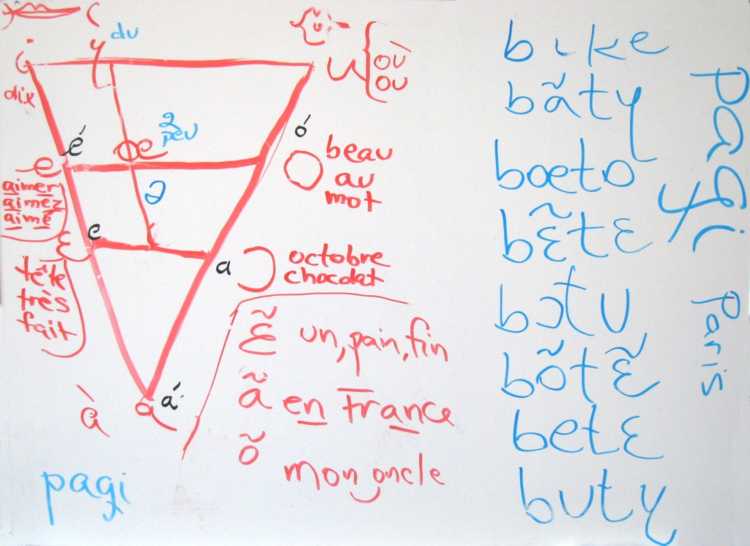
Hand-drawn phonetic chart

Whiteboard as photographed by a student in my actual classroom. (I redraw the picture as needed for the benefit of each student).

Hand-drawn phonetic chart

A more prosaic guide to French pronunciation (with fewer colors) can be found HERE. Click on whatever sound you want to hear.

Posted in Language Tips | Tagged | 1 Comment

Check out “Lingo Babe” for French pronunciation

Want to hear how various French words are pronounced? Choose either “Lingo Babe” or “Lingo Dude” to pronounce whatever word you want to hear. A riot! The site is an ad but, if you send it to someone (yourself?), you can hear the words 4 or 5 times. No translations, just pronunciations.

Posted in Language Tips | Tagged , , | 1 Comment

Learning a second language will protect your brain!

Stave off mental decline by learning a second language! A recent study echoes Dr. Andrew Weil’s observation shows that “the best mental workouts I can think of are learning a new computer operating system and learning a new language.” (Dr. Andrew Weil on his website, http://www.drweil.com)

The “dazzled” researchers of the separate study concluded that “Bilingualism may help delay dementia symptoms.”

The study was published in the February 2007 issue of Neuropsychologia (Vol. 45, No. 2).

Dr. Weil adds that “you don’t have to master the language”to get the benefits. “It’s like using different software through the system. It’s extremely beneficial.”

Posted in Reasons to learn French | Tagged , , , , , | Leave a comment

A common mistake (in no book)

Students often use the expression “ça va” as an adjective. I’ve heard, for example, “Le film était ça va,” to mean the film was “OK.” A French person would have no clue what that sentence meant.

“Ça va” means “it’s OK,” in the sense that things are going well, but it is a sentence unto itself rather than an adjective.

If you need an adjective, “acceptable” would do or “médiocre.”

To incorporate “OK” in a sentence, you would need the appropriate tense of “aller” and, most likely, since it’s informal, the subject “ça” with no other verb. For example, in response to the question, “How was the film yesterday?” one could say “Ça allait,” meaning “it was OK.” If someone is worried about the future, a friend could respond reassuringly that “Ça ira” in the future.

Posted in Language Tips | Tagged , , , | 2 Comments