
Duras Retrospective – cinematic and personal

To celebrate Marguerite Duras’ centennial, Lincoln Center is showing a retrospective of her films. It was also 45 years ago  last month that Lincoln Center presented the first of her films ever to be shown in America. The film was known in English as Destroy She Said.

I was a grad student, writing my dissertation on her work at the time.

Lincoln Center 69.Duras4

Duras and me (with film festival program in hand) in front of Lincoln Center, September 1969

It was September 1969, France was still reverberating from its ’68 rebellion,  and the film – slow, no action, political allusions,” etc. – was so different from any American entertainment that many people walked out of that showing.

A day or two later, I translated for her during a meeting at Columbia University and then hosted her at Harvard, where we projected the same film at Carpenter Center. I translated the questions and answers during the discussion, not yet used to such long answers that make you forget the beginning by the time you reach the end of the sentences. She spent around a week at my house in Cambridge, joined after a few days by her son Outa.
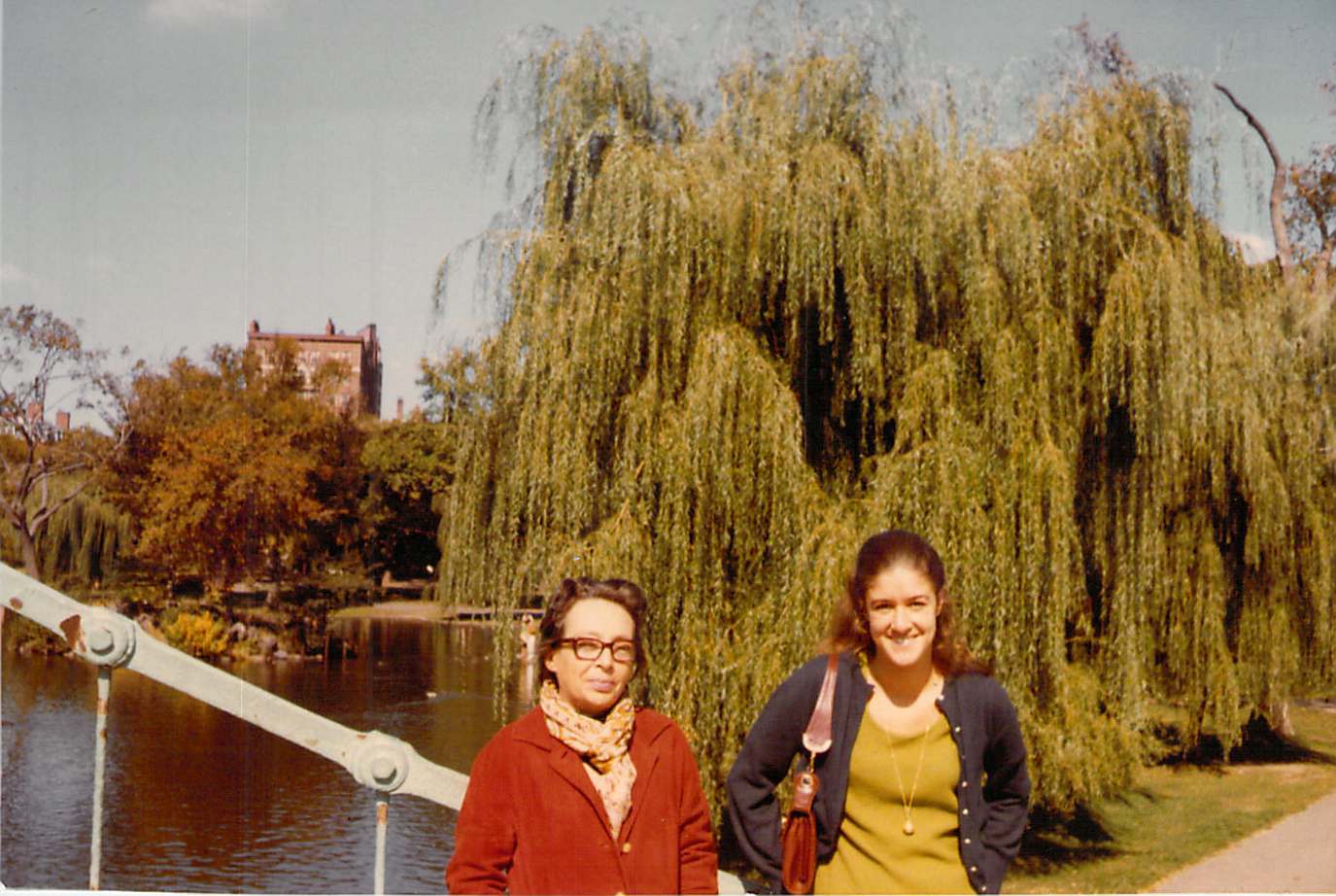
Public Garden 69.Duras3

At Boston’s Public Garden

The most unusual things I remember about her visit were her insistence that we American students rebel against society and – on a whole different register – her delighted astonishment at our grey squirrels!

Posted in Cultural Perspectives, Films, French culture, French-American politics | Leave a comment

Has Wrong become Right?

This is the Teachers’ Dilemma that’s been bothering me for years now: which form do I teach my students? Our grammar books give the definitions of to remember as: se rappeler and se souvenir de.  Current language has merged the two, infecting se rappeler with the de of se souvenir. Wrong! All native French speakers – even scholars! – get it wrong according to the textbooks.

After hearing the ‘mistake’ so often, I asked 3 three different friends whose judgement I trust. The first, a distinguished psychoanalyst, declared that no respectable French person would use se rappeler without the de.

The second, a linguistics professor, declared it a “faute” that has been around a long time. It takes her one second more effort, she said, to drop the de after se rappeler. “Il me semble qu’il y a à l’œuvre deux principes : un principe d’analogie et un principe d’économie. C’est que dirait du moins une linguistique fonctionnelle : 1) : l’analogie : pour les locuteurs, ce qui se ressemble par le sens devrait se ressembler par la forme -2) le principe d’économie (= préférer le simple au compliqué, surtout rechercher ce qui demande moins d’effort). Dans ce cas, ils vont dans le même sens.”

The other linguistics professor said he uses the verbs differently and agreed with the economical theory, saying, “la recherche du meilleur rapport qualité-prix reste le principe moteur. Ce n’est pas un laissez aller à la déchéance, mais au contraire la recherche du meilleur rendement possible de chaque effort et de chaque élément de connaissance linguistique.”

I guess the error is similar to the English one that confuses who and whom and that uses words like hopefully wrong. It’s the difference between prescriptive and descriptive grammar. Which is preferable? I give my students the choice.

Posted in French versus English, Language Tips | Tagged , , | Leave a comment

Word of the Month, August

I love French verbs that have no direct English translations. We can tell what they mean, but they are so concise, we have no one-word equivalents: fragiliser, relativiser, positiver, responsabiliser. A weird one that’s not even in the dictionary: dérembourser! You can tell what they mean but have to use several words to express them in English. There are more; can anyone name some? … There’s also the opposite like “to pack” is faire les valises.

Posted in Language Tips | 1 Comment

Middle-agers: Study a Language !

You must read the July 15, 2014 Opinion by William Alexander in the New York Times: “The benefits of failing at French”
” Last year researchers at the Chinese University of Hong Kong and Northwestern University in Illinois hypothesized that […] the things that make second-language acquisition so maddening for grown-ups are the very things that may make the effort so beneficial.

“The quest for a mental fountain of youth, pursued by baby boomers who fear that their bodies will outlive their brains, […] has created a billion-dollar industry. There is some evidence that brain exercise programs like Lumosity and Nintendo’s Brain Age can be beneficial, but if my admittedly unscientific experience is any indication, you might be better off studying a language instead. Not only is that a far more useful and enjoyable activity than an abstract brain game, but as a reward for your efforts, you can treat yourself to a trip abroad. Which is why I plan to spend the next year not learning Italian. Ciao!”

Read the whole piece at:

Posted in Boston French classes, Observation of the month | Tagged , , , , | Leave a comment

Attention: Fans de Duras !

La Voleuse, le film sur lequel je viens d’écrire va être retransmis une 4e fois en 2 mois ce vendredi, 18/7, à 3h30 du matin (c.à.d, jeudi après minuit). Une occasion de voir un film de Duras pas connu par le grand public.

Posted in Films, French culture | Tagged , , | Leave a comment

Perils of Mixing up “Tu” with “Vous”

Carolyn V. sent the following wink at the perils of confusing Tu and Vous:
http://www.latimes.com/opinion/op-ed/la-og-bastile-vous-tu-20140711-htmlstory.html
The dangers are serious! Already at 21, I made a peer feel that I was presumptuous when I said “tu” to a good friend of a close friend of mine – both French, of course. I heard about it the next day!
Another put-down was when a “tu” slipped out of my mouth to a younger French woman I only knew professionally. Her response: “On n’a pas élévé les vaches ensemble!” Quelle horreur!
I got a reprimand from Bobby, a high school student of mine who, in France for the summer, must have addressed an aristocrat as “tu.” Why hadn’t I told my students about the “you” problem, he complained in a post card. Of course, I had – in Lesson 1 – but he was probably thinking of something else then.
No matter how long we American democrat people know the rules, though, we can never feel it the way the French do.

Posted in Cultural Perspectives, French culture, French versus English, Language Tips, Only in France ! | Tagged , , , | 1 Comment

Duras’s ‘stolen’ movie

Why did Marguerite Duras not get more credit for having written La Voleuse? TV5 Monde has broadcast the otherwise ordinary-looking 1966 black and white film 3 times recently without advertising or mentioning ahead that it’s a film by Duras. I myself started watching it with no idea she had written it even though I had written my doctoral dissertation on her and knew her since 1973. But then, she didn’t exactly get the writing credit. The opening screens announced that it’s a “un film de Jean Chapot,” a “un Scénario de Jean Chapot” and “D’après une idée générale d’Alain Fatou et Jean Chapot.” Only after that, when most people’s eyes glaze over, do they add “Dialogues de Marguerite Duras.”

How is it possible that she wrote the dialogue but not the scenario?! Turns out: the film was based on a real-life crime scandal at the time. I’m guessing that Jean Chapot and Alain Fatou had the idea to make a film about it and asked Marguerite to write the dialogues. That, I’m hypothesizing, was their contribution. The film sounds too much like Duras not to have been her take on the entire crime.

It’s a variation on Moderato Cantabile and many of her other works. Its location – a dull, factory town dominated by smokestacks; its main male character – a factory worker like Chauvin but, instead of Jean-Paul Belmondo, it’s a young Michel Piccoli; and the themes – the conflation of love, madness and death along with the power of the maternal bond.

There is even scene in Voleuse that is practically identical to the climax in Moderato. The couple sit at a restaurant (or bar) table across from each other, the husband says to his wife: “Je t’aime mais je pourrais te tuer.”
Moderato, written about the same time, has the couple sitting opposite eachother at a bar, when Chauvin says to Anne: “Je voudrais que tu sois morte.”

Laure Adler quotes a commentator who says that Duras ‘stole’ the film from the director. The press was accepting it as a work of Duras. “Duras fait du Duras.”

For all of you Duras fans, if TV5 Monde broadcasts it again, I recommend you watch it and add it to your knowledge of her.

Trailer for La Voleuse (1966): http://www.youtube.com/watch?v=NI8HQY7Mkrc

German Wikipedia article on the film: http://de.wikipedia.org/wiki/Schornstein_Nr._4 (“Chimney #4”)

Laure Adler: Marguerite Duras (Gallimard, 1998, p. 414), writeup of La Voleuse in a biography of Duras in French

Posted in Cultural Perspectives, Films, News from France | Leave a comment

Words of the month, July 3

I love French verbs that have no direct English translations. We can tell what they mean, but they are so concise, we have no one-word equivalents: fragiliser, relativiser, positiver, responsabiliser. A weird one that’s not even in the dictionary: dérembourser! You can tell what they mean but have to use several words to express them in English. There are more; can anyone name some? … There’s also the opposite like “to pack” is faire les valises.

Posted in French versus English, Language Tips, Observation of the month, Reasons to learn French | Leave a comment

New word: Europhobes

Ta Da!
New Feature of Back Bay Français: Language Tip of the Month!

Two new French words have sprung from the recent victory of the Front National (far right) in the election for the European Parlement: “europhobes” et “eurosceptiques.” It seems that the FN is both of these adjectives, which makes sense. Will they want to exit the European Union now that they have the French majority in the European Parlement? Other parties are also not eager to continue in the EU but Marine Le Pen, party leader, announced that hers is “le seul véritable groupe eursceptique” that will lead in this direction.
Related Language Tip : I’ve noticed that when the French abbreviate words or coin new contraction words, they tend to end the word or the stem in “o” – just as in these two words. Some other good ones: le labo (lab), le phallocrate (sexist), un ado (adolescent), un apéro (apéritif), un dico (dictionary), les sciences po (sciences politiques). “Il est accro” means ‘He’s a drug addict.’ (accro <accro – hung up).
Can anyone add more examples?

Posted in French culture, Language Tips, Observation of the month | Tagged , , , , | Leave a comment

New French Words Bring French Alive

La Semaine de la langue française et de la francophonie s’est passé en mars mais son action continue jusqu’en juin. So you can still check out the new vocabulary, play with the words, and add them to your own conversation.

Check out the full list and comments by Nabum, a blogger for Mediapart.

We’ve heard some of them before. The one hated most by the commentator Nabum is the one I appreciate the most: ‘enlivrer.’ (A sort of pun on the words for ‘book’ and ‘to get drunk’. The feeling is ‘getting drunk on a book’). Whereas he thinks it’s ugly and feels derogatory, I feel that ‘Je m’enlivre’ evokes how I sometimes feel after I’ve read a good book, a great feeling. ‘Lire’ doesn’t transmit that feeling. But then, I’m not a native francophone so maybe I don’t feel it ‘right.’ But then, isn’t that part of what makes a living language alive?


Posted in Language Tips | Tagged | Leave a comment