The importance of the humble baguette – Part 3

Stephanie writes:

So attached are the Parisians to their beloved baguettes, that I have even been in quite a few Chinese or Indian restaurants, where there has been a basket of baguettes on the table (just in case?). The French love to use pieces to push food around their plate so it comes in handy even if it doesn’t really fit the culture or style of the meal. And, after all, you need something to mop up all the good sauce! Also in regular restaurants / brasseries you don’t get a little side bread plate like in the US. You put your piece of baguette, crumbs and all… right there on the table next to your plate.

Also it seems to be forbidden for all of the boulangeries to be closed on the same day.  In my neighborhood, all the bakeries are always open Saturdays and Sundays but then one might be closed on Wednesdays while the others stay open – yet another might close on Thursdays, etc., but there will be an open Bakery somewhere. You can pretty much always access a Baguette. In case of emergency, though, I do freeze freshly purchased loaves and keep them on hand. The trick is to wrap the baguette in a cotton “torchon” and it keeps very well.

My 8 year old son has been absolutely begging to be allowed to go buy the bread alone. He says that his friends are allowed to buy the baguette by themselves, and he insists it’s not fair! Is this some kind of French Rite of passage… the first purchasing of the baguette on one’s own? So, since there are boulangeries close by everywhere, and no major streets to cross, we recently said “OUI”.  Now it is his job to buy the baguette on Saturdays and Sundays. He proudly counts out the 85 centimes (or 1.10 for une tradition) from a big jar of change that we have on the kitchen counter and off he goes happily, feeling very independent.  He returns a few minutes later, strolling up the alley, like everyone else in the neighborhood, with a warm baguette under one arm.
boulangerie


Posted in French culture, Only in France !, Stephanie | Tagged , , | Leave a comment

The importance of the humble baguette – Part 2

Stephanie continues:

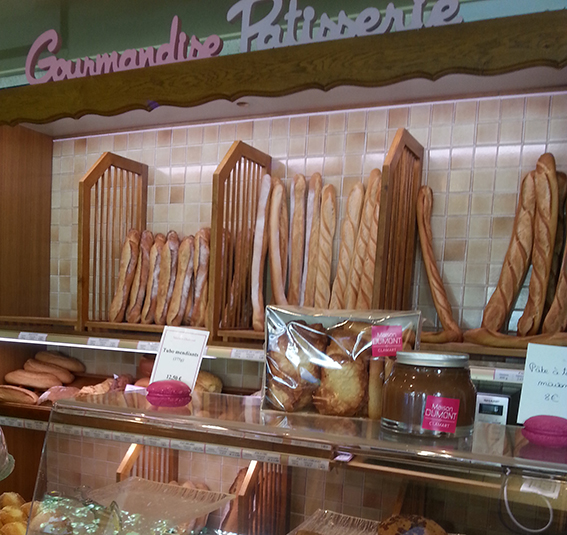
When I first moved here, I thought that to buy a baguette, you walked into the boulangerie and simply said “une baguette, s’il vous plait”. Little did know, that 99% of French people SPECIFY “au moins” the “cuisson” of their bread. Sort of like ordering a steak medium, or well-done, a baguette can be requested “bien cuit” or “pas trop cuit”. Note that the customers will not hesitate to reject the loaf presented to them, and gesture or point to another one in their line of vision that has caught their eye! The serveuse does not take offense at all… par contre, she will pick through the loaves on racks and in the baskets as needed until the perfect one is attained! This may annoy others in line, but they will do the same when it’s their turn as it’s very important that you get your baguette as you like it. I also learned that there is more than just la baguette … there is baguette “tradition”, “de campagne”, “retrodor” and “baguette moulée” (and the list goes on…). There are different nuances to each type of bread. The “mie” is softer, or has a different crumb, the crust is harder or chewier, the flour is slightly different, the loaf is a somewhat different shape or length. And by the way, it’s perfectly fine to request half a baguette only, or to ask for it “coupé en deux”. But you would never ask for it “tranché” . Here, as far as I see, you tear the baguette off the loaf – acceptable even in polite company or in a “resto”, you do not have to cut it with a knife at all. You can ask for other breads “tranchés” but never a baguette! When handing it over, the serveuse will wrap a small paper and twist it (covering the middle of the bread only) or put it in a paper sack, with the end sticking out. It gets handled and handed over just like that, no latex gloves needed, no problem.

boulangerie la fourche

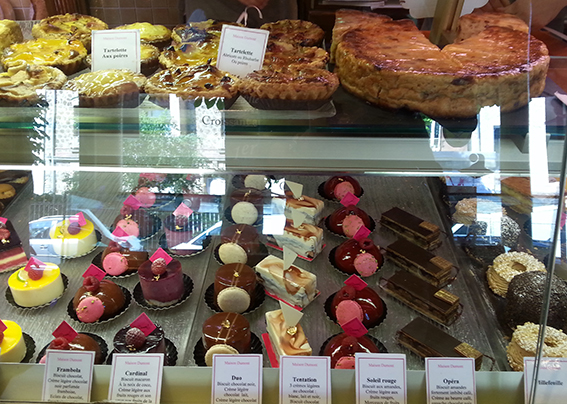
In addition to the baguettes, of course, there are many other breads and “viennoiseries” and don’t get me started on the patisseries. It took me a while to learn the subtleties of the breads. I am still not so confident about which is a “Paris-Brest”, or a “Mille-feuilles” or a “Religeuse”! But the experience of it all is part of the charm. When I go to the boulangerie, I usually have my small daughter with me, who smiles wide-eyed at her beautiful confections, says Bonjour messieurs mesdames, and runs behind the counter to give her favourite serveuse “un petit bisou et un petit calin”.  She then receives with a flourish “une chouquette” –free of charge– a delightful little puff of dough covered in crunchy sugar crystals…. Or, other times, a beignet, un petit pain-au-lait or un mini financier. Vive les boulangeries, is all I can say. If I had to move away tomorrow, I would miss my warm baguette (so comforting, especially trudging home in the cold, after working all day… the pleasure of having a hot bread to warm your hands and nibble as you go). Sometimes, I pick the children up from school, we buy a baguette walking home, and it’s mostly gone by the time we reach our front door! When I lived in the US, bread was something pre-sliced in a plastic sack from the supermarket… something I just had on hand to make the occasional tuna sandwich, and very often there was no bread in the house; it wasn’t that important. Now, if there is no bread, I will hear the family shouts echoing throughout the household “Quoi! il n’y pas de pain!? T’as pas pris le pain?? Qui va acheter le pain? Il faut du pain!!”

Posted in French culture, Only in France !, Stephanie | Tagged , , , | 1 Comment

The importance of the humble baguette – Part 1

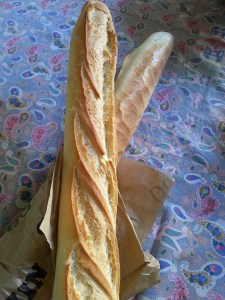
the perfect baguette

Stephanie writes:

I never knew, before I came here, how important la Baguette is to the French. For example, my mother-in-law gets panicky if, during dinner, she notices that the bread is disappearing too fast, like say, the kids are gobbling it up… She may even start to horde it a bit. She wants to be sure there is enough bread for her breakfast the next morning. She toasts baguettes and slathers them with confiture for her petit dejeuner…So, after dinner, she wraps the leftover bread in a tea towel to keep it for the next morning and then she doesn’t have to run to the boulangerie in the morning. But it’s so important, she will get really bent out of shape if there is no bread. It’s just funny – because in the USA,  a lot of times I had no bread, or if I ran out of bread – I would just eat something else…I really didn’t care…. But here its like “le pain!! Le pain!!! Il faut du pain” Pas de pain equals the end of the world!!! My husband as well… It’s like you can’t have a meal without “ le pain”… I can remember literally us all sitting down and starting to eat a meal,  and his realising there was no bread, leaving the table and the house to go get a baguette for the meal…. To me, it’s like – hey the food is hot, let’s just eat! Who cares if there is no bread. But then…. I’m not French!!

Before I moved to Paris, I wondered if everyone walked around with a beret on their head and a baguette under their arm. Of course that is a stereotype – but the part about the baguette is not that far from the truth! Baguettes are so quintessentially Parisian and so ubiquitous!

When we are “à table”, my family often play the game “Guess where the baguette was purchased?”. There are so many bakeries everywhere and all the baguettes are ever-so-slightly different. Now I can pretty well tell the difference between all of them. I have become a bit of a connoisseur. We even have nicknames for all the closest Boulangeries so after we taste, we call out  “Rue Hébert!”  or “Près du station BP!”, “La Fourche!”,” Rue Lazare Carnot!” or “ A côté de l’école!” Everyone in the family has their favourite.

Posted in French culture, Only in France !, Stephanie | Leave a comment

A New Translation of L’Étranger + A New View of Meursault

Etienne R. just sent us a review by Claire Messud of a new English translation of L’Étranger. It’s big news because, as the reviewer wrote, it’s “One of the most widely read French novels of the twentieth century.” The reviewer trumpets the latest translation, from 2012, comparing it favorably to the the original 1946 one and to three more recent ones, two from the 80s.

Whereas she correctly points out that “Each translation is, perforce, a re-envisioning of the novel: a translator will determine which Meursault we encounter, and in what light we understand him,” we, who read the classic year after year in its original French with our intermediate classes, are left to our own interpreting devices. We perceive him from our own perspectives, probably somewhat tarnished from the repeated readings.

I would love to hear opinions from other French teachers. In the meanwhile, I must say that where Claire Messud, sees Meursault’s nature” to be “accommodating,” I find it to be “indifferent.” While she finds him “painfully without pretense,” I find him indifferent and passive.

She gets the essence of everything else she points out, all the points that we French teachers highlight in our classes, but I’ve spent too much time with the character to find him anything else but apathetic.

Posted in Boston French classes, French culture | Leave a comment

Part 1 of this series was: Cute stories Part 1

Stephanie writes:

It’s fun to think about language, as well!!… Sometimes I don’t know what my son is saying. For example both my kids called “musique” :  zique-mou (not sure how on earth you would spell it but it is pronounced like Zeek-moo…and Léo (jokingly will say meuf for femme although I think it’s derogatory so I discourage that) or they come up with some other slang that baffles me and I have to ask, what’s that? And they always say funny stuff –like I’ll say “go brush your teeth” and Leo will say” “Ca roule, ma poule!” or “let’s go to the store now” :“C’est parti, mon kiki!”…. or Claire when she is en train de faire un bêtise:  “mais j’suis sage comme une image !!”etc etc, I love their little expressions..

I also think sometimes my daughter would prefer that I were not American… like, she doesn’t want me to be different from the other Mamans. Lately when I speak English she gets mad and says “Maman parles Francais!!!” It’s like I’m an extra-terrestrial. When I get her at school and say “put on your coat” all the little kids stare at me, like who is that weirdo and what is she saying?? So a lot of times I speak French because everyone in my family and around me is always speaking French! And it’s really hard to answer back in English when everyone is speaking French all the time.

But I know I make mistakes in french – like often I forget the article, so I say things like “Claire, tu veux pates?” and so then she starts talking a bit  like me (Je veux pates!) because it’s what she hears…… and then my husband gets really mad and says “Its : tu veux DES pates…jes veux DES pates… speak french correctly or speak english because otherwise they will learn incorrect french!!!” I would like it if we could speak English in the home but although my husband can speak English, he doesn’t really want to! I guess its odd that at this point it really has to be Eric that helps Leo with his homework and not me, because it’s not my native language…sometimes that makes me a bit sad or feel left out.

Posted on by Susan | Leave a comment

Cute Stories of an American Mommy Bringing up Two French Kids

Stéphanie C. is writing us again. She now has two French kids, a French husband, and a French job. Fully immersed in Parisian life for several years now, she writes: “It’s fun to think about language!!… Sometimes I don’t know what my son is saying. For example, both my kids call “musique” : “zique-mou” (not sure how on earth you would spell it but it is pronounced like Zeek-moo) … And Léo jokingly will say “meuf” for “femme” or they come up with other slang that baffles me and I have to ask, what’s that? And they always say funny stuff –like I’ll say “go brush your teeth” and Leo will say “Ça roule, ma poule!” or I’ll suggest “let’s go to the store now” to which he responds, “C’est parti, mon kiki!”…. As for Claire, when she is en train de faire une bêtise, she’ll say,  “Mais j’suis sage comme une image !!” I love their little expressions.

I also think sometimes my daughter would prefer that I were not American… like, she doesn’t want me to be different from the other Mamans. Lately when I speak English, she gets mad and says “Maman, parle Francais!!!” It’s like I’m an extra-terrestrial. When I pick her up from school and say “put on your coat,” all the little kids stare at me, like who is that weirdo and what is she saying?? So a lot of times I speak French because everyone in my family and around me is always speaking French! And it’s really hard to answer back in English when everyone is speaking French all the time.

But I know I make mistakes in French – like often I forget the article, so I say things like “Claire, tu veux pates?” and so then she starts talking a bit  like me (Je veux pates!) because it’s what she hears…… and then my husband gets mad and says “Its : tu veux DES pates…je veux DES pates… Speak French correctly or speak English because otherwise they will learn incorrect French!!!”

Posted in French culture, Language Tips, Stephanie | Tagged , , , | Leave a comment

Examples of Michèle L’s Sites That are Worth a Visit

So many people asked me for examples of Michèle L.’s sites, that she sent us some URLs.

1 – Voici un site pour le tourisme à Paris, qui donne des indications classiques mais parfois des propositions moins connues : “un jour de plus à Paris”.  On peut s’abonner je crois: Un jour de plus a Paris: The Paris tourist guide on the internet.

2 –  Pour des “promenades Urbaines” ou “balades urbaines” et  “www.quartiersdart.com”
D’autres sites sont plus orientés vers les quartiers populaires, la banlieue. Pour nous (les Parisiens) c’est très intéressant; j’aime bien y participer de temps en temps. Pour les Américains, ceux qui connaissent déjà et veulent comprendre le fonctionnement du “Grand Paris” (= avec banlieue, donc pas seulement à l’intérieur du périphérique) seront peut-être intéressés:  Google search for ‘promenades urbaines’

3 -Je te joins aussi une annonce que je viens de recevoir sur une manifestation prochaine à Belleville, quartier populaire devenu “à la mode” et où il est réellement agréable d’habiter (Traces, 2014):  TRACES à Belleville

4 -Sur l’attraction naisssante de la banlieue pour des expérimentations artistiques, si tu tapes “galeries d’art banlieue Paris” tu trouveras des articles. Ou directement par exemple “la banlieue appâte les galeries” (Libération)” Ou encore plus direct “Galerie Gagosian Pantin”. “Galerie Gagosian Le Bourget”. Tu peux aussi taper “Mac Val Vitry”. Même le Figaro a fait un article en ce sens (voir “Figaroscope”).

5 – Enfin, un document sur le quartier de la Villette, qui a beaucoup changé et est devenu très agréable surtout aux beaux jours: Le quartier de la Villette à Paris.

Posted in Cultural Perspectives, French culture | Tagged , , , , , | Leave a comment

More New Sites Non-Parisians Don’t See in Paris:

Michèle M. continues to share with us the new developments in Paris that visitors don’t know about. The following two sites are for those who can spend more time there:

L’étranger qui séjournerait davantage pourrait apprécier les petites novations locales dont profitent les Parisiens dans presque tous les quartiers. Certains sont des échecs, ou des demi-réussites, mais d’autres améliorent vraiment l’environnement. En voilà deux:

Par exemple :
1- Déjà ancienne, la transformation de la « Petite Ceinture » en promenade verte continue – malheureusement trop lentement, pour des raisons d’argent. Dès qu’un segment ouvre, les Parisiens se précipitent pour inaugurer cet espace de promenade utilisant l’ancienne voie de chemin de fer qui entourait Paris et qui a été longtemps désaffectée. A terme, cela devrait couvrir tout le périmètre de Paris ! Il y a des zones agréables (par exemple, à l’Est dans le 12e arrondissement), d’autres plus récentes et actuellement plus ingrates  (vers le parc Georges Brassens dans le 15e).

2- L’aménagement des quais de la Seine du côté du 7e arrondissement (à partir du quai d’Orsay pour l’instant) se discute, mais incontestablement cela change le rapport au fleuve. D’une toute autre manière à l’est de la Gare d’Austerlitz, dans le 13e arrondissement, le bord de Seine n’a pas été aménagé; l’hiver il est même assez sinistre et vide, mais dès les beaux jours, les bateaux sont investis, des sortes de cafés assez populaires sont installés et c’est très gai. C’est aussi un des lieux où les soirs de week end, les jeunes se réunissent pour boire, faire de la musique (etc !) : il n’y a pas beaucoup de lieux de cet ordre dans Paris car c’est une ville très dense et le bruit gêne le voisinage. Ici, il n’y a pas de voisinage…donc les jeunes sont libres.. Tout cela est récent : quelques années !

Posted in French culture, News from France, Tourism in France | Tagged , , , , , , , | Leave a comment

What Non-Parisians Don’t See in Paris

Michèle tells us what we, visitors, don’t see in Paris. She’s giving us an overview here, first, and in the next few days, we’ll get some details.

Il y a une grande tendance : le déplacement progressif de la vie sociale, culturelle, de loisirs, vers l’Est et surtout le Nord-Est. Bien sûr les quartiers « chics » traditionnels où se font les affaires, où sont les grands musées, où habite la bourgeoisie classique demeurent intacts. Mais il se crée au Nord et à l’Est  une urbanité différente: des artistes, des professions « branchées », des populations ethniquement mixtes,  jeunes etc; ils investissent des lieux, provoquant un changement culturel. Les loyers sont moins chers, les quartiers sont plus animés, plus variés, peu à peu ces zones, à l’origine très pauvres, sont partiellement réhabilitées. Cela correspond à la fameuse « gentrification » des quartiers populaires (avec inconvénients et avantages) qui touche plus ou moins toutes les villes, avec le règne des bobos. Et ce mouvement s’étend : il avait commencé dans les années 1970 dans le Marais et le 11ème arrondissement (Bastille), puis s’est étendu dans tout l’Est, remonte aujourd’hui vers le Nord (devient un quartier réhabilité et intéressant). Un quartier de plus en plus prisé – effectivement j’aime bien m’y promener – est l’ensemble formé par les abords du Canal Saint Martin, les quais de Seine et de Loire à partir de Stalingrad et les extensions le long de l’Ourcq vers la banlieue (Pantin, Aubervilliers).

Si, lorsqu’ils sont à Paris, tes amis de Boston ne vont pas les soirs d’été vers Stalingrad, le bassin de la Villette et les quais du canal de l’Ourcq, il faut le leur recommander très vite ( avec, par exemple, un dîner ou apéritif à la Rotonde de la Villette, petit chef d’œuvre du 18ième siècle).

Image

(Canal Saint Martin. Photo de http://cs.wikipedia.org)

Posted in Uncategorized | Tagged , , , , , | Leave a comment

What are the subtleties of KIFFER ?

Could a kind and well-informed French-speaking person explain the subtleties of the verb “kiffer” ?  I’ve heard it a lot and gathered it meant ‘to like,’ ‘to love’ or ‘to appreciate.’ But then I read in the daily Libération that Erik Orsenna, the respected author and member of the Académie française, tell Libération (below) it should become an official French word and that its origin is in the drug world, I realized I don’t understand it as completely as I thought. Voilà ses mots:

“Il n’y a pas d’équivalent dans la langue française, qui n’est pas figée pour jamais. C’est un mot très concret qui provient de la drogue, pour représenter une sorte d’addiction. Mais les mots entrent dans le dictionnaire de l’Académie à long terme, et pas seulement après une ou deux années d’existence.”

As Phildange suggested here before, I’m limited by my own intellectual world so don’t know that meaning.


Posted in Cultural Perspectives, French culture, Language Tips, News from France | Tagged , , , , , , , , , | 1 Comment